
Essentialism in Alisa Palavenis\’ painting exhibition \”Alisa\’s Miraculous Morphoses\”
On June 22, 2023, the \”Alisa\’s Miraculous Morphoses\” painting exhibition of the artist Alisa Palavenis was opened at the gallery “Aidas” in Vilnius. The works presented by the painter reveal a personal look at the surrounding everyday life (the exhibition exhibits still lives), archetypal natural scenes (landscapes) and images of contemporary culture (pop art and abstract works).
The compositions of the paintings presented in the exhibition are reminiscent of the 20th century. The works of Southern European painters of the 6th-8th decades are characterized by the fact that the works of the so-called \”purists\” painters of this period did not emphasize the careful toning of three-dimensional forms but the primordial potential of colours to serve as a symbol of some archetypal beginning (earth, water, sun).
Accordingly, in her still lifes, A. Palavenis chooses exceptionally bright natural artefacts unusual for our [Lithuanian] region – eucalyptus flowers, tangerines, and ripe apples. These objects shine in the paintings in their original colours, unfaded by the atmosphere, light and shadows (e.g. the picture \”New Mandarines\”, acrylic, 2019). However, unlike purist painting, which looks for primary and stereotypical earth colours, the painter introduces bright cyan and emerald shades in her works as a counterweight to the sharpening natural tones of the depicted objects. Such a sense of colour shows the desire to match the eye-catching nature with bright shades: artificial objects made by human hands – coloured pencils, bottles and draperies are used as unbalancing elements in the composition. The still lifes laid out in the space of the canvas have explicit compositional axis or spatial structure. However, the negative space surrounding them has the same expressive importance – it is an ether, a poetic void, painted with intense colours breathing in the tropical climate [In art, negative space is the space around and between the subject of the image. The positive space is the subject or object of the picture].


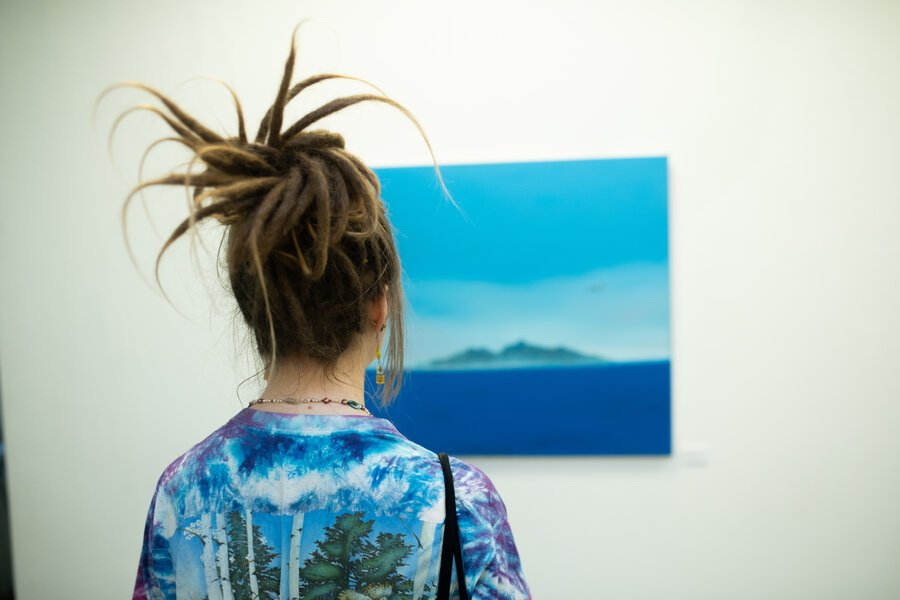
Moments from the opening of the exhibition (Photo Viktorija Chorna)
The colour intensity and contrasts of the still lifes are transmitted to the landscapes presented in the exhibition: azure blue, ultramarine and orange shades convey the heat of the sunny climate and heightened senses. The landscapes are strongly abstracted; they depict nature\’s primary, essential, pure elements – the limpid sky, the intense blue sea and the silhouettes of mountains. For such a landscape constructed entirely from primordial elements, a poetic, symbolic subtext is given
– in the painting \”Late Awakening\” (oil, 2023), we see a male figure focused on the unfolding event on the horizon. The symbolic figure does not have any signs, attributes or clothes that betray its social status – the figure itself is simply a shadowy sign onto which the viewer of the painting can project his vision – feel how he would react if a fantastic mirage began to appear before his eyes. The images of a narrow, oppressed space (i.e., an island on which a human figure stands) and a boundless, undefined sea with a strange spectacle that captures attention – also poetically echo the literature spaces of the mid-20th century (both, for example, Antoine de Saint-Exupéry\’s \”The Little Prince\” and Ernest Hemingway\’s \”The Old Man and the Sea\”), where the theme of the intersection of man and the elements of man and the universe is highlighted.
In the painting \”Fantasy Forest\” (oil, 2022), trees are depicted as a graphic indexical symbol – their silhouettes resemble leaves arranged neatly on stems. This collage or fragmented composition of landscape paintings echoes the fragments of figurative paintings by René Magritte (1898-1967), Salvador Dalí (1904-1989) and Lucien Coutaud (1904-1977) and partly by Francis Picabia (1879-1953).
The primordial nature of southern landscapes is further accentuated by inclusions – the surface of the painting \”Was I there?\” (acrylic and pumice stone, 2020) contains pieces of coarse sand mixed into the paint. The theme of inclusions and samples partly reflects the painter\’s primary profession, her pharmacist\’s experience; A. Palavenis creates the essence of the depicted phenomena by incorporating, e.g., Petri plates (\”Petri Flowers\”, installation on canvas, 2022). The collage aesthetic is finally transferred to abstract compositions – the painting \”A Different Dance\” (acrylic, 2023) uses eucalyptus leaves, macadamia shells and malachite, marking the primordial essences of colours and textures. The abstract paintings recall the aesthetics of the abstract paintings of Peter Heron (1920-1999) and Joan Miró (1893-1983).
However – if the purist painters focused only on natural colours – the works of A. Palavenis are characterized by synthetic magenta, purple and pink shades, responding to the pop-art period not only with the chosen colour but also with actualized themes (paintings \”Hanna Pours Milk\”, oil, 2023 and \”In the World of Mannequins\”, watercolour and acrylic, 2023). The composition of the painting \”Follow My Dreams\” (oil, 2023) by imitating the screen image of the social network Instagram shows that the chosen synthetic colour is used to capture the core of contemporary popular culture.
The paintings presented in A. Palavenis\’ painting exhibition \”Alisa\’s Miraculous Morphoses\” are of different genres. However, the painter\’s affinity for the aesthetics, colourfulness, symbolism and compositional features of purist, surrealist and pop art paintings that prevailed in the mid-20th century, her ability to interpret them in a modern way in the present allows her to actualize the general idea of the pure essence of the world\’s objects, spaces and images in various plots.
Art critic Gytis Oržikauskas. Translation from Lithuanian to English by Alisa Palavenis
Article sources:
https://www.7md.lt/daile/2023-06-23/Esencializmas-Alisos-Palavenis-tapybos-parodoje-Alisos-stebuklamorfozes
The painting exhibition \”Alisa\’s miraculous Morphoses\” by Alisa Palavenis at the art gallery “Aidas” was open from June 22 until July 23, 2023, address Jaksto str. 9, Vilnius, Lithuania.
more info: GALLERY